Prop Firm Trading Strategy
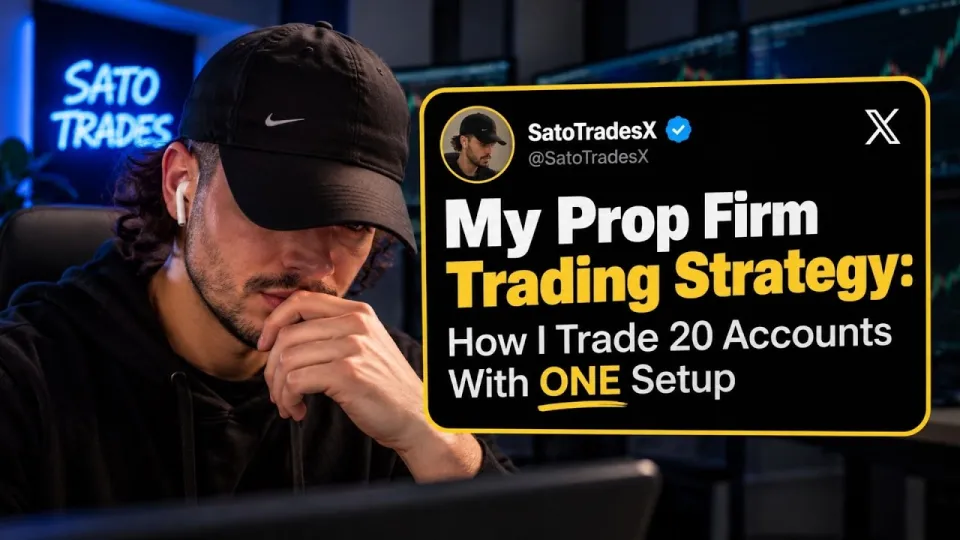
Video: Prop Firm Trading Strategy: How to Pass a Funded Challenge in 2026
· based on the channel Sato Trades
Passing a prop firm challenge requires a precise and mechanical trading strategy that balances risk management with consistent execution. A reliable prop firm trading strategy involves trading futures, primarily on the 1-minute chart, to pinpoint entries using daily and intraday key levels on indices like ES (E-mini S&P 500) and NQ (E-mini Nasdaq). Traders should mark these levels on TradingView for clarity and confluence, then set limit orders, stop losses, and take profits before leaving the trade to run.
Understanding the Prop Firm Trading Strategy
The core of the prop firm trading strategy is a mechanical system that removes emotional decisions by clearly defining entry and exit points based on technical levels. Traders use marked daily support and resistance levels alongside intraday potential long and short zones. Confluence with high timeframe levels strengthens trade setups.
The strategy is designed for futures trading, focusing on the 1-minute timeframe to capture efficient entries and exits. By strictly following these levels and market structure rules, traders avoid impulsive trades and reduce risk.
Marking Levels and Using TradingView Tools
Accurate level marking is critical. Traders identify key daily ES & NQ levels before the market opens and plot them on TradingView. Grouping and hiding levels helps maintain a clean chart, allowing focus on relevant zones. Intraday levels highlight potential long and short areas for scalping or swing trades.
Using TradingView’s tools, traders can visually manage multiple levels and recognize when price approaches confluence zones. This visual aid is essential for consistently spotting high-probability setups during the trading session.
Market Structure and When Not to Trade
A significant part of the strategy is understanding when to avoid trading. Market structure analysis helps identify unfavorable conditions—such as volatile choppy price action or when price is breaking major levels without confirmation.
Traders should refrain from entering trades if the market lacks clear direction or if price action contradicts the identified levels. This discipline prevents unnecessary losses and protects the funded account.
Risk Management Principles
Risk management is paramount to passing prop firm challenges. The strategy recommends setting stop losses and take profits in advance and not adjusting them once the trade is active. This approach preserves capital and ensures consistent payouts.
Risk per trade should align with the prop firm’s rules, usually a small fraction of the total account value. Using limit orders to enter at precise levels and stop losses to cap losses helps maintain a mechanical, emotion-free trading routine.
Scaling Through Multiple Accounts
For traders seeking to increase funded capital, scaling through multiple prop firm accounts is effective. Using trade copiers, like those offered by Tradovate, allows managing up to 20 accounts simultaneously.
This scaling technique requires discipline and adherence to the same mechanical strategy across all accounts. It diversifies risk and accelerates growth in prop firm trading capital.
Common Questions About Prop Firm Trading Strategy
Traders often wonder how to best learn and implement these strategies or choose suitable prop firms. The strategy includes daily shared levels and bias in subscription services like Sato VIP, which provides ongoing tutorials and market insights.
Additionally, understanding the rules of each prop firm’s evaluation and funded phases is crucial. Different firms may have variations in risk limits, allowed instruments, and payout structures.
Useful Links
- Daily ES & NQ levels subscription and tutorials: https://satotrades.com/vip
- Best Futures Prop Firms full guide: https://satotrades.com/guides/best-futures-prop-firms
- Free Discord for daily levels and community support: https://discord.gg/Yt5PuQjXRp
- Trade copier service for managing multiple accounts: https://portal.tradecopia.com/signup?via=SATO
Итог
A well-structured prop firm trading strategy centers on mechanical entries on the 1-minute futures chart using specifically marked ES and NQ levels. Strict risk management with predefined stop losses and take profits protects the funded account and helps secure consistent payouts. Avoiding trades during poor market structure conditions and scaling through multiple accounts can enhance profitability. The channel Sato Trades offers comprehensive guidance and tools to master this approach and increase the chances of passing funded challenges successfully. For ongoing support and daily levels, visit Sato VIP.
Key takeaways
- Uses a mechanical 1-minute futures trading system for entries
- Focuses on daily ES & NQ key levels marked on TradingView
- Strict risk management with set stop loss and take profit
- Avoid trading during unfavorable market structure conditions
- Scales trading through multiple accounts using trade copiers
Source: Prop Firm Trading Strategy: How to Pass a Funded Challenge in 2026 · Markdown version
Questions & answers
What is the best timeframe for a prop firm trading strategy?
The 1-minute chart is recommended for precise entries in futures trading, allowing traders to capitalize on short-term price movements with clear entry and exit points.
How important is risk management in passing prop firm challenges?
Risk management is critical; traders must set stop losses and take profits before entering trades to protect their funded account and ensure consistent payouts without emotional interference.
Can I trade multiple prop firm accounts simultaneously?
Yes, scaling through multiple accounts is possible using trade copiers, which allow managing up to 20 accounts with the same mechanical strategy to diversify risk and grow capital faster.
Where can I find daily trading levels and further guidance?
Daily ES and NQ levels, along with tutorials and market bias, are available through subscription services like Sato VIP, which also offers community support and mentorship.